Poor Knights Islands Deep Dive Sites
Northern Arch

 64m to north of arch |
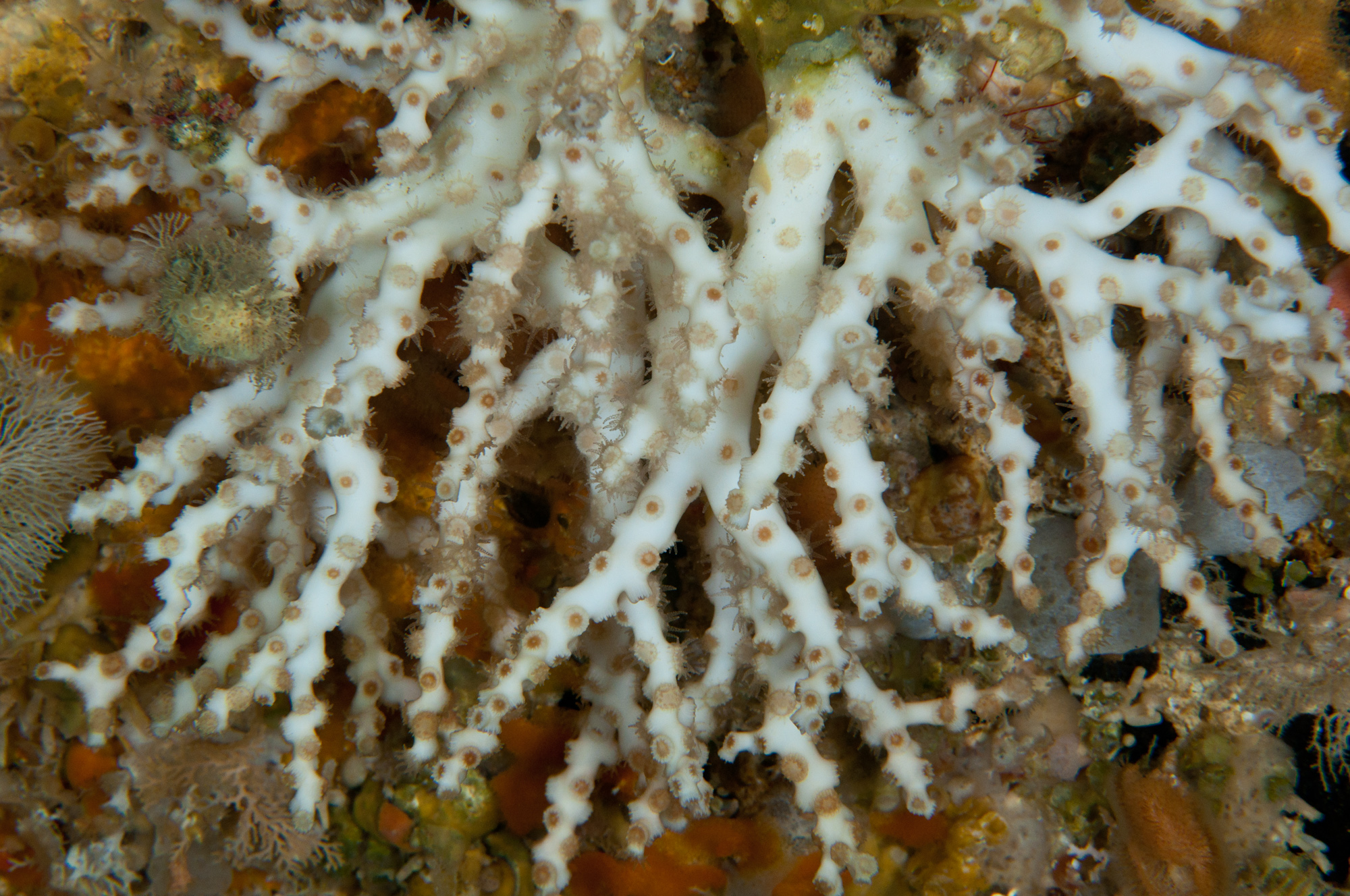
 Oculina boulder at 60 m |
 Redbanded weever (Parapercis binivirgata) at 64m |

|
The walls to the north of the arch receive more direct sunlight and are the better side to spend time decompressing. Rich encrusting life grows in the shallows which are a productive area for finding unusual tiny nudibranchs. |
|||||||



Cream Garden
The anchorage is well sheltered from southwest weather and the site is suitable for divers of all levels. |
 Huge boulders at 66m Huge boulders at 66m |
 Golf-ball sponges at 40m Golf-ball sponges at 40m |
Barren Arch
A deep dive can be readily commenced from the usual anchorage just to the north east of the arch. Descending to the bottom at around 15 metres and swimming straight out to sea, the reef drops in a series of steps and a gentle swim has you at 60 metres in about 8 minutes. Rocky reef and large boulders tumble down a little further to the white sandy bottom at 65 to 68 metres depth. Greater depth can be achieved by heading towards the point at northern side of the Barren Arch inlet. Alternatively, turning towards the south before ascending up through a jumble of large boulders allows deco time to spent inside the arch with its beautiful moody lighting and colourful encrusting life.
Ngaroimata Point
At Ngaroimata Point, the underwater cliff face drops dramatically to nearly 75 metres depth. This is one of the best vertical drops at the Knights and is probably only rivalled by the Sugarloaf and wall outside Light Shaft Cave.
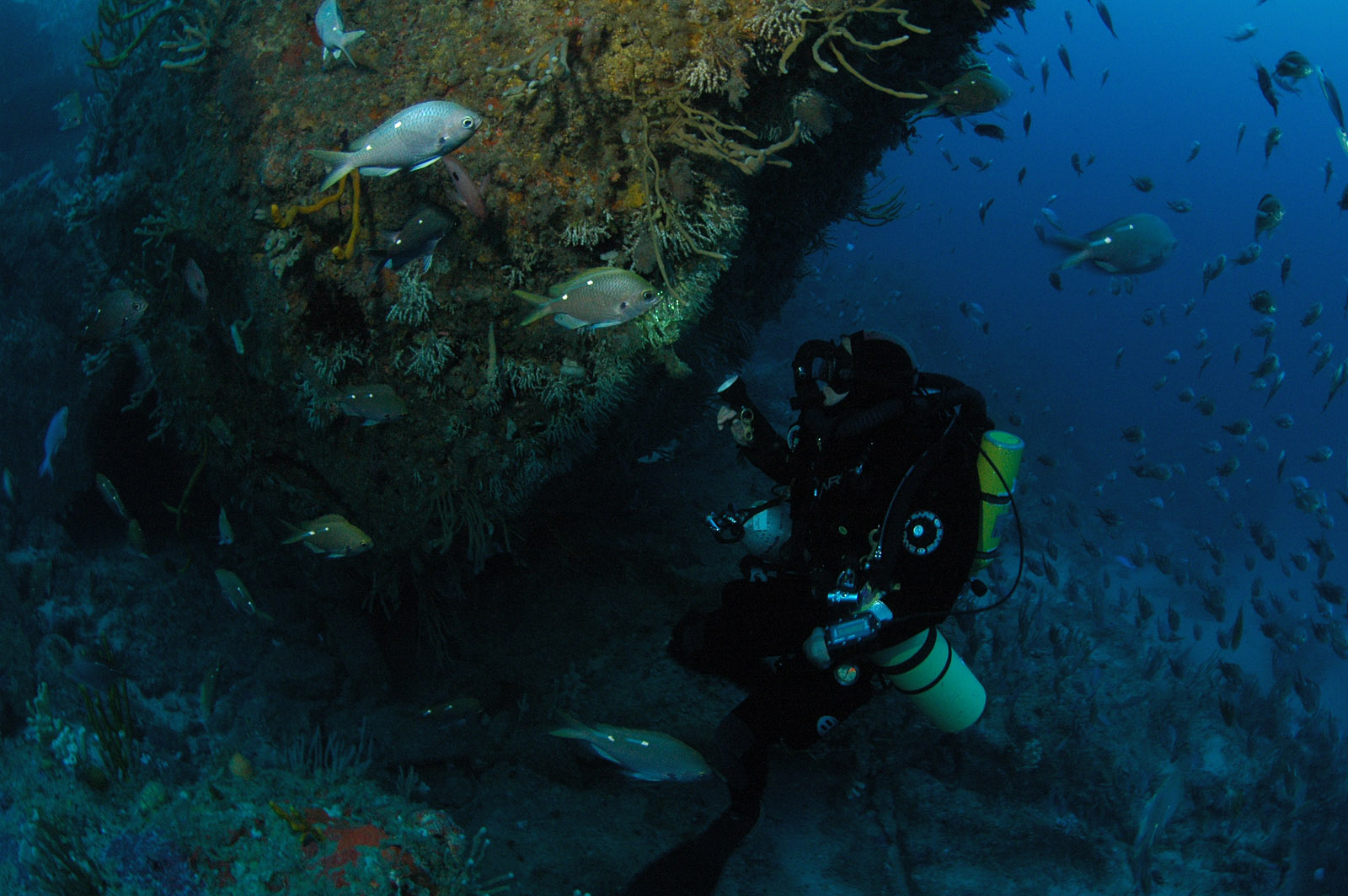
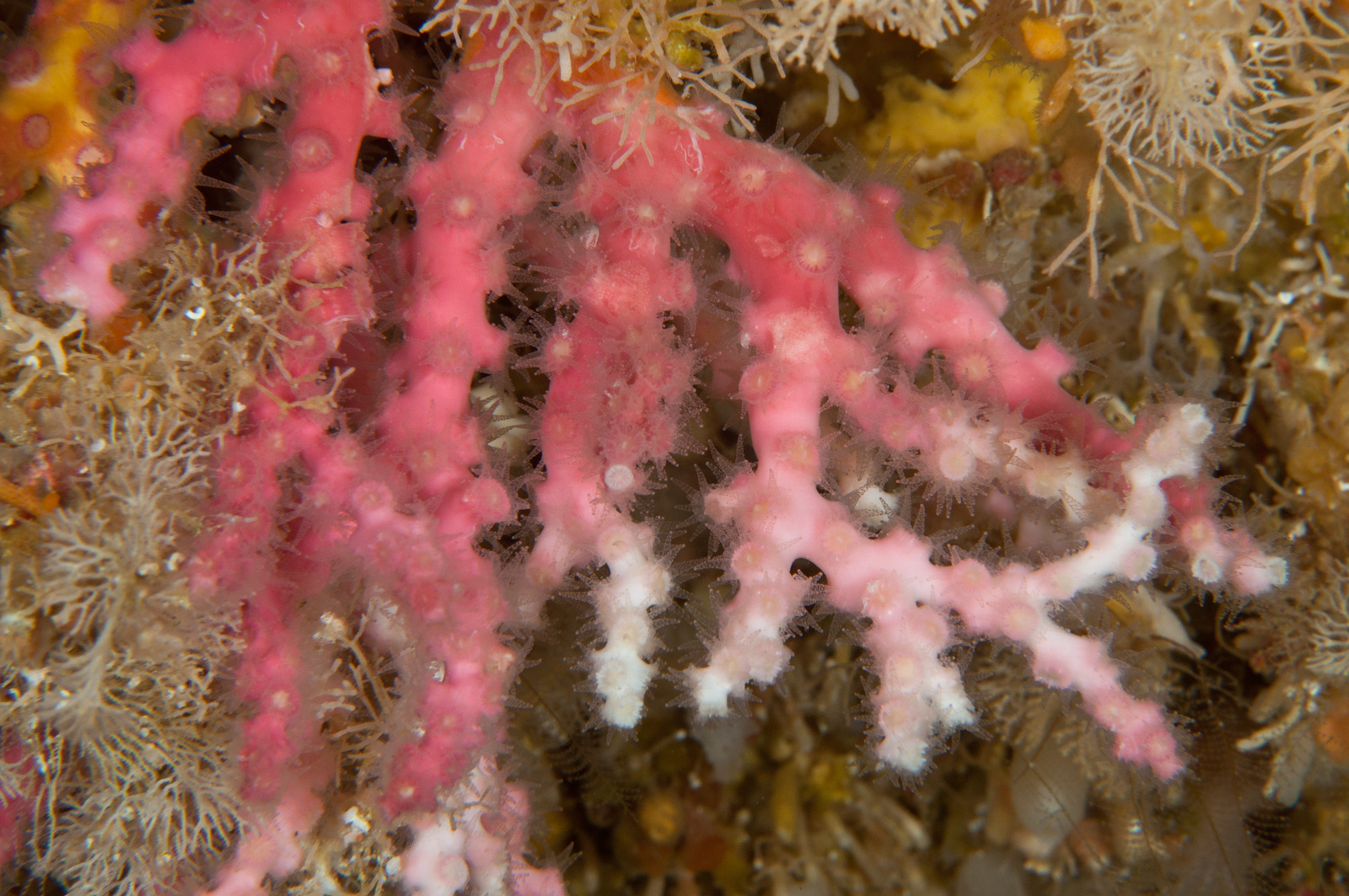
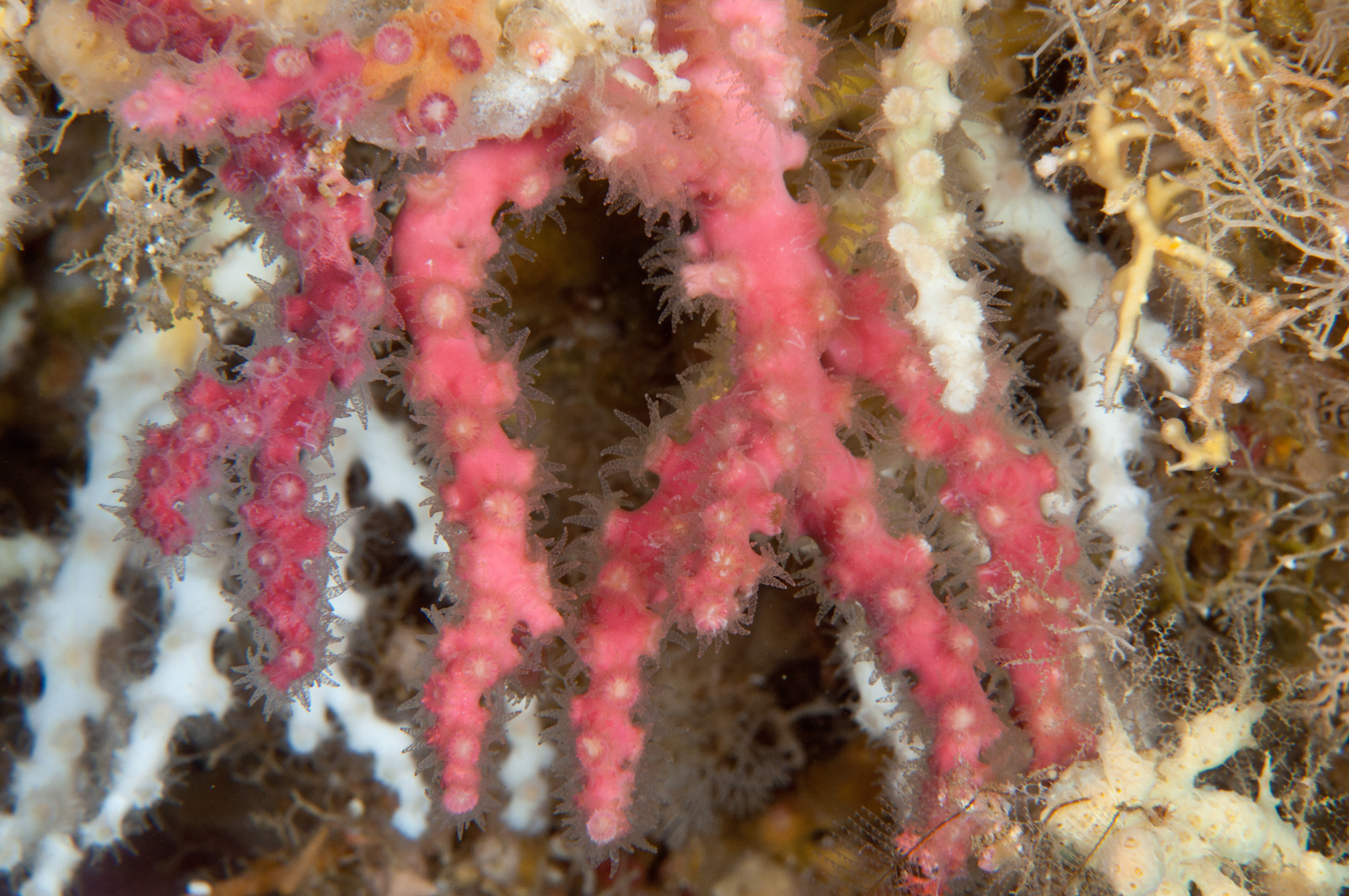
North of the point towards Barren Arch, an enormous boulder, the size of a double garage, has an overhanging face at 60 metres depth covered with colonies of white and pink Oculina.


| Landing Bay Pinnacle Landing Bay Pinnacle provides a sheltered, easy-to-navigate site with easy access to 60+ metres depth. Dropping off the southern side of the pinnacle, you meet the white sandy bottom at around 50 metres. Following the reef-sand line in a clockwise direction, the sand slopes away and at the western flank a vertical wall rises up about 20 metres from the sand at 65 metres. Continuing around, the sand starts to slope up and there is a nice area of broken reef and sand rubble at around 55 metres where we have found the redbanded weever (Parapercis binivirgata) resting on the bottom. |
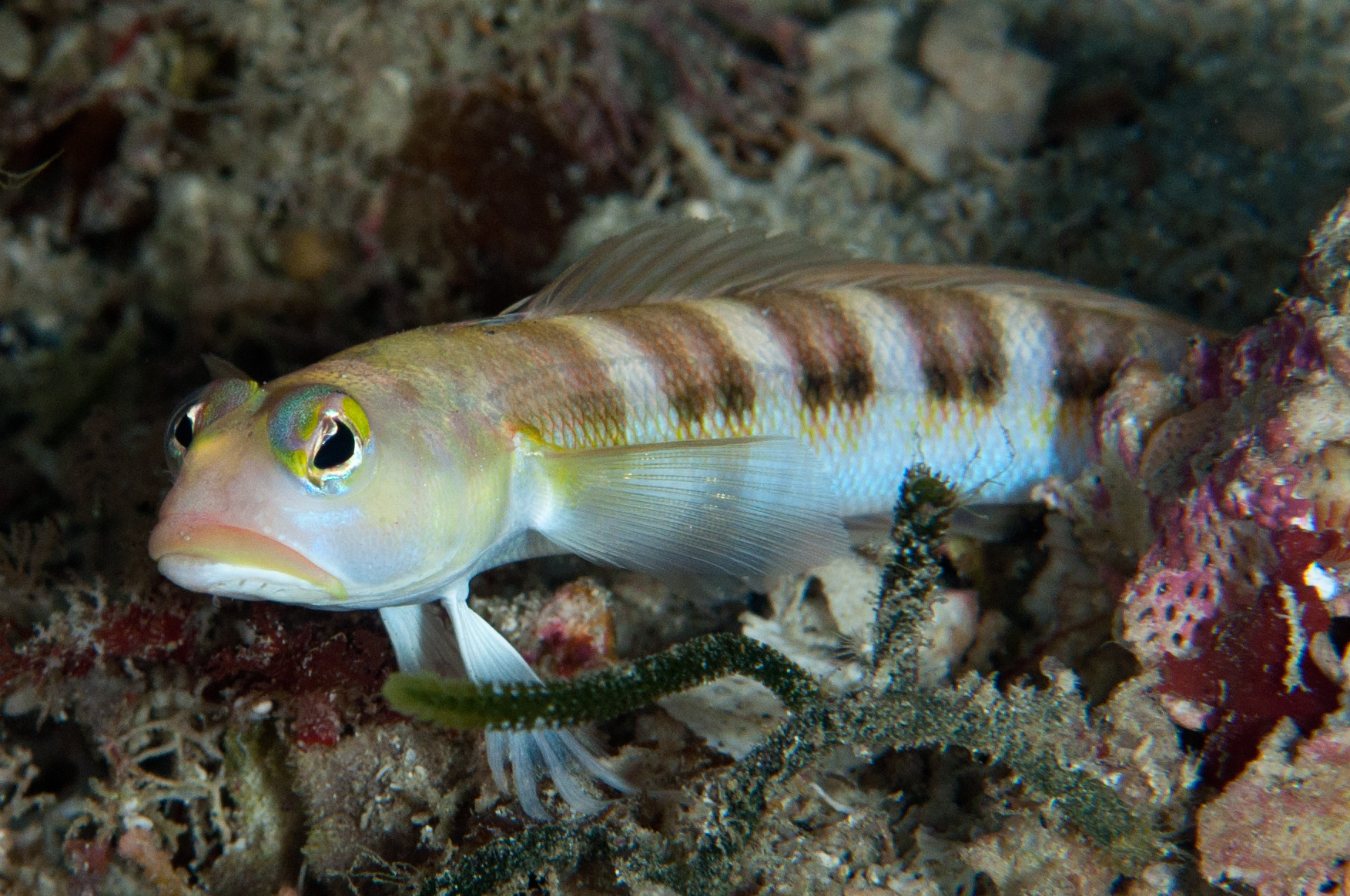 Redbanded weever
at 55m Redbanded weever
at 55m |
 Chromis abyssicola at 60m Chromis abyssicola at 60m |
Twelve Fathom Reef
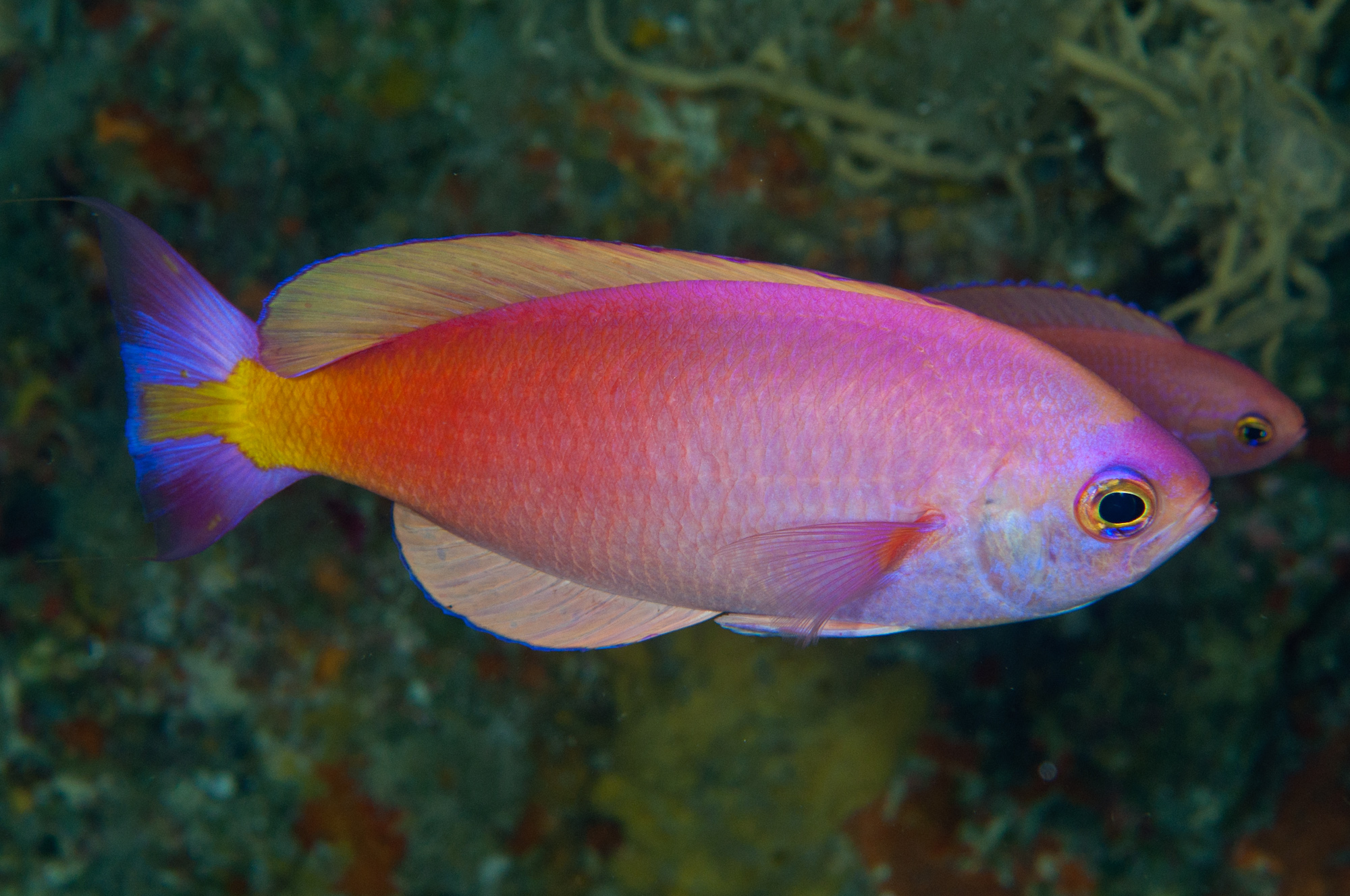
| This rocky pinnacle rises to within 23 metres of the surface and drops away steeply on its northern side to a sloping sandy bottom at 75 metres. At depth, the walls are covered with yellow finger sponges and the occasional large tube sponge. There are some scattered small black coral trees but they are not a major feature of this area. Splendid perch are abundant below 60 metres and school with masses of demoiselles and pink mao mao. At the north western corner, a nice vertical wall rises up 20 metres or so from the sand. A horizontal slot near its base (at approx 62m) is home to an Eyebrow perch (Hypoplectrodes sp.). Coordinates: 35.468S 174.727E |
|||



The Canyon
Although not as deep as some other sites, the area has interesting patches of deep water reef broken up by white sand, and is home to beautiful gardens of sponges, gorgonians and black coral trees.
On the point off The Canyon, the wall drops steeply to small rocky plateau at 57 metres depth from which a rocky finger extends out onto the sand at 62 metres. The rocks in this area covered with yellow finger sponges and Primnoides gorgonians but the most spectacular feature are the many large organ-pipe sponges (Calyx imperialis). Some of these are up to a metre in height and 300 mm in diameter at the mouth of the tube. A number of black coral trees can also be found in this area.
The Canyon itself is a narrow sandy bottomed channel with rocky walls which provides picturesque route for divers during their descent or ascent.
A hapuku (Polyprion oxygenios) has been sighted in The Canyon at 45 metres depth.
 Hapuku at 45m 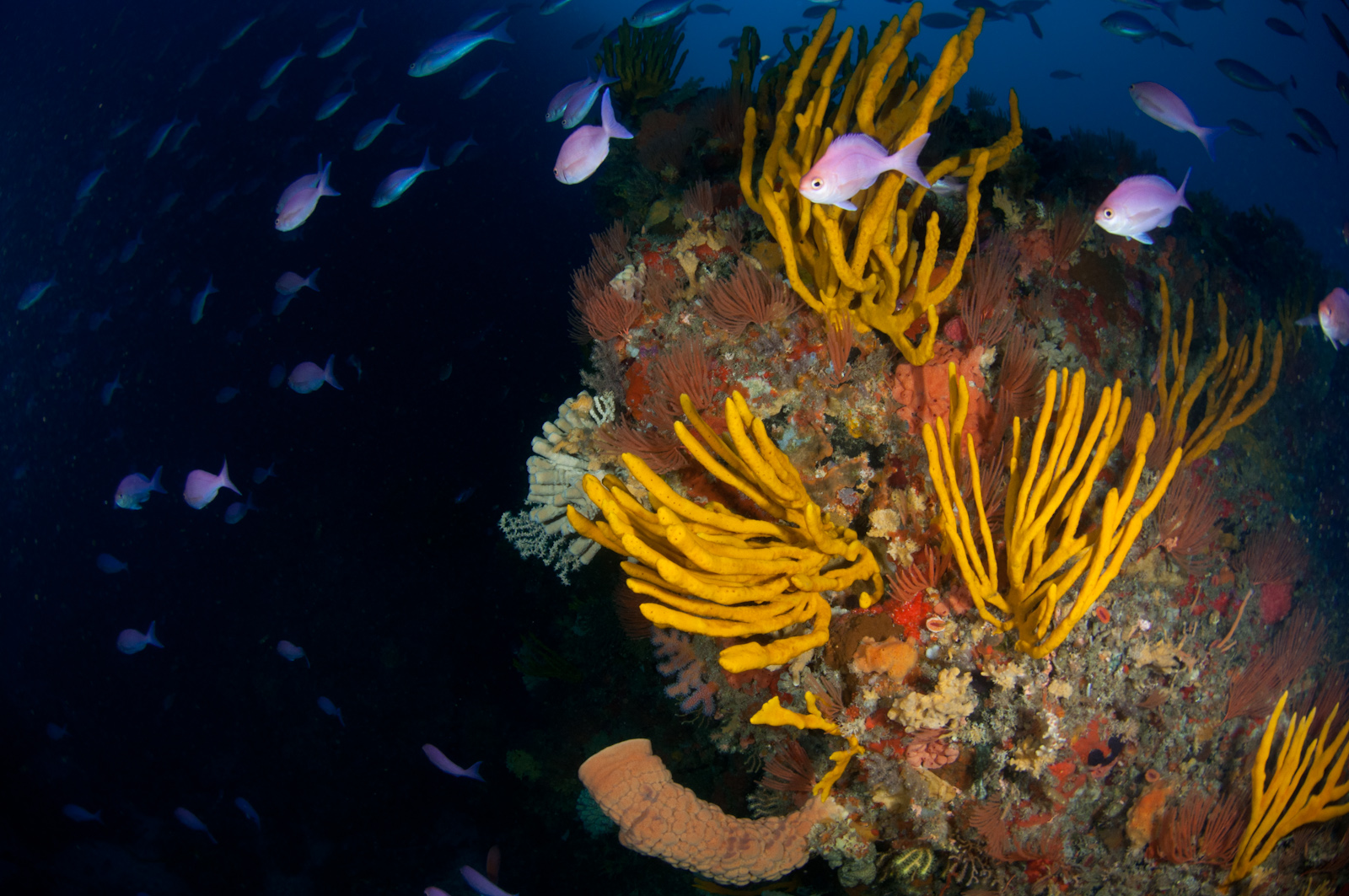 Sponges at 57m |
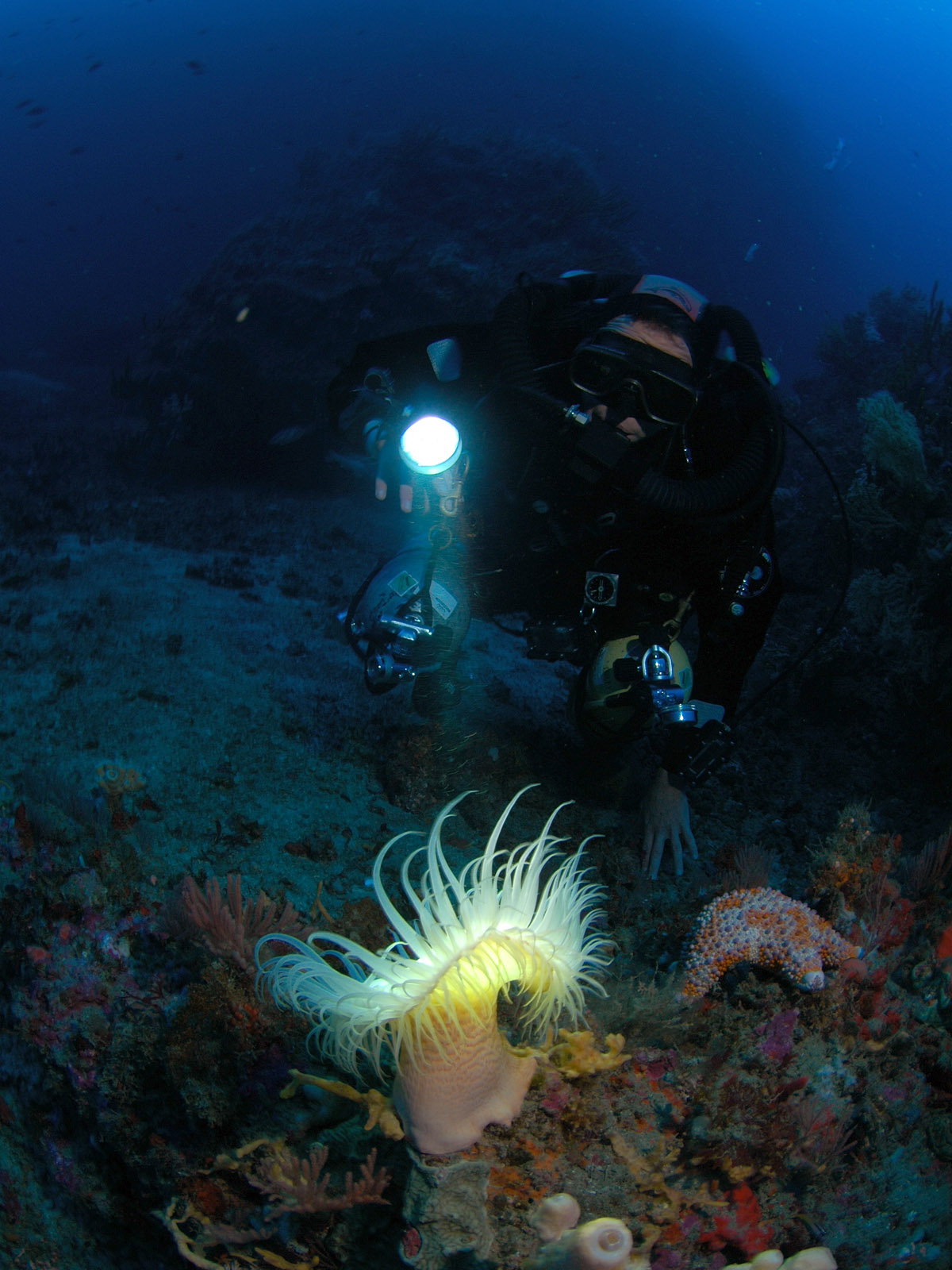 Unusual white anemone at 57m |
 Large orgen-pipe sponge at 60m |
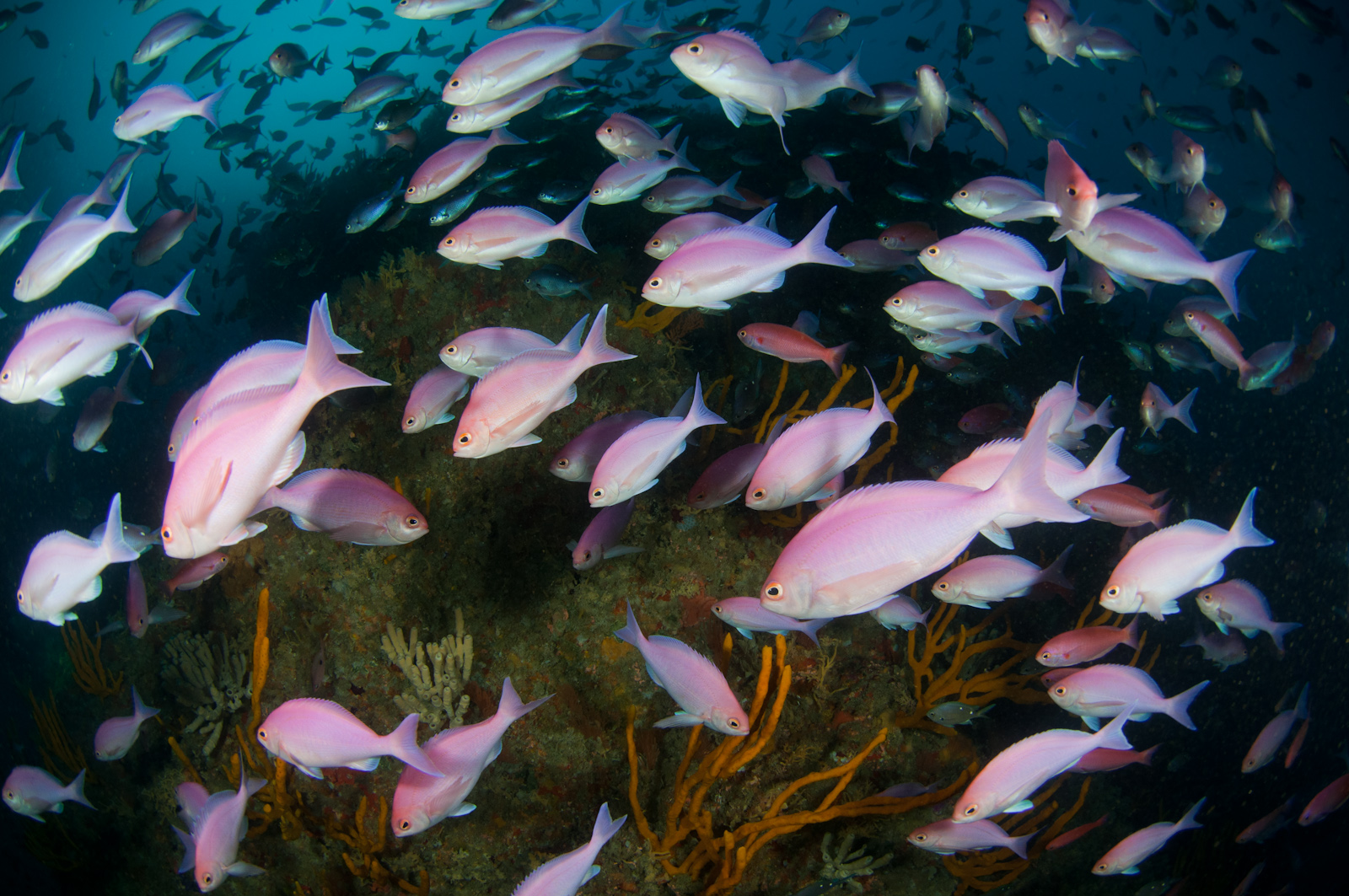 Pink maomao & splendid perch at 57m  Divers at 58m with sponges |
Bird Rock
 Foxfish at 60m |
On the eastern side of Bird Rock the reef drops away quickly to a bottom of steep rocky outcrops separated by patches of white sand. The sandy patches begin at about 55 metres and level off at around 65 metres. The reef is covered with gardens of sponges, many of which are shaped as bowls or tubes. Foxfish have been seen here at 60 metres. |
 |
Oculina Point
| At between 35 and 45 metres depth, ridges project out from the wall creating an increased current flow and encouraging the growth of some of the largest and most beautiful gorgonian fans to be found at the Poor Knights Islands. These gorgonian clad walls are very reminiscent of deeper reefs at The Three Kings Islands where the ivory coral, Oculina virgosa is common. I haven't yet found any Oculina at this site but I'm sure there's some lurking down there beneath an overhanging rock face. As the point is approached from the north, the reef drops steeply to the sandy bottom at 55 to 60 metres. On the point, large rocky features extend further out and meet the sand at around 75 metres. Rocks in this area are covered with yellow finger sponges, gorgonians, and some black coral trees. Strong currents can be experienced at this site. Under such conditions it is difficult to swim around the many small rocky outcrops but there are also plenty of vertical guts which offer shelter from the current. Hunkering down in a gut for your deco may be preferable to over exerting yourself trying to fight the current. |
 Black coral at 60m |
 Sponges and gorgonians at 62m |
Imagination Point


Wade's World (North of Labrid Channel, outside Jan's Tunnel) |
|||
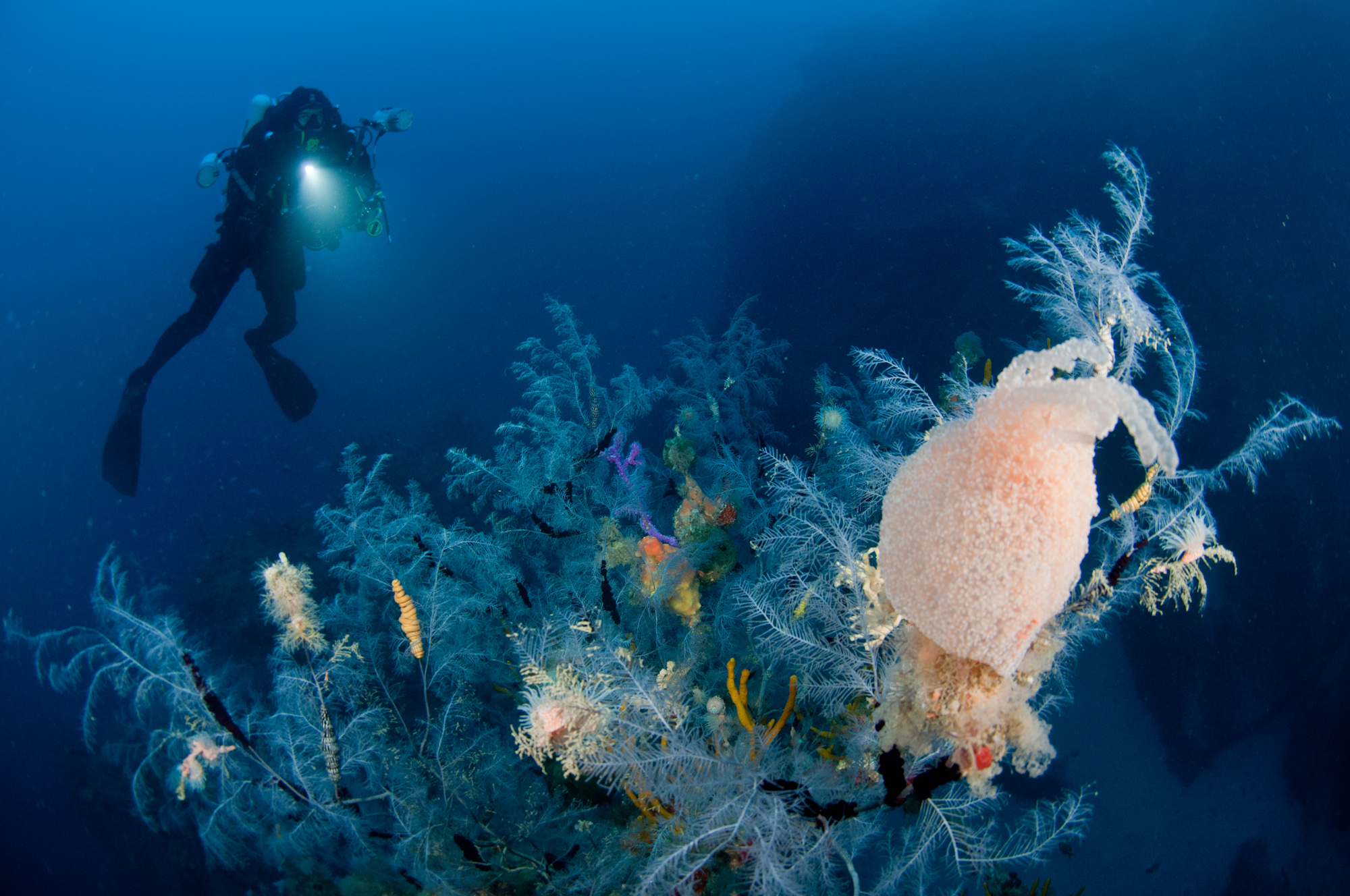
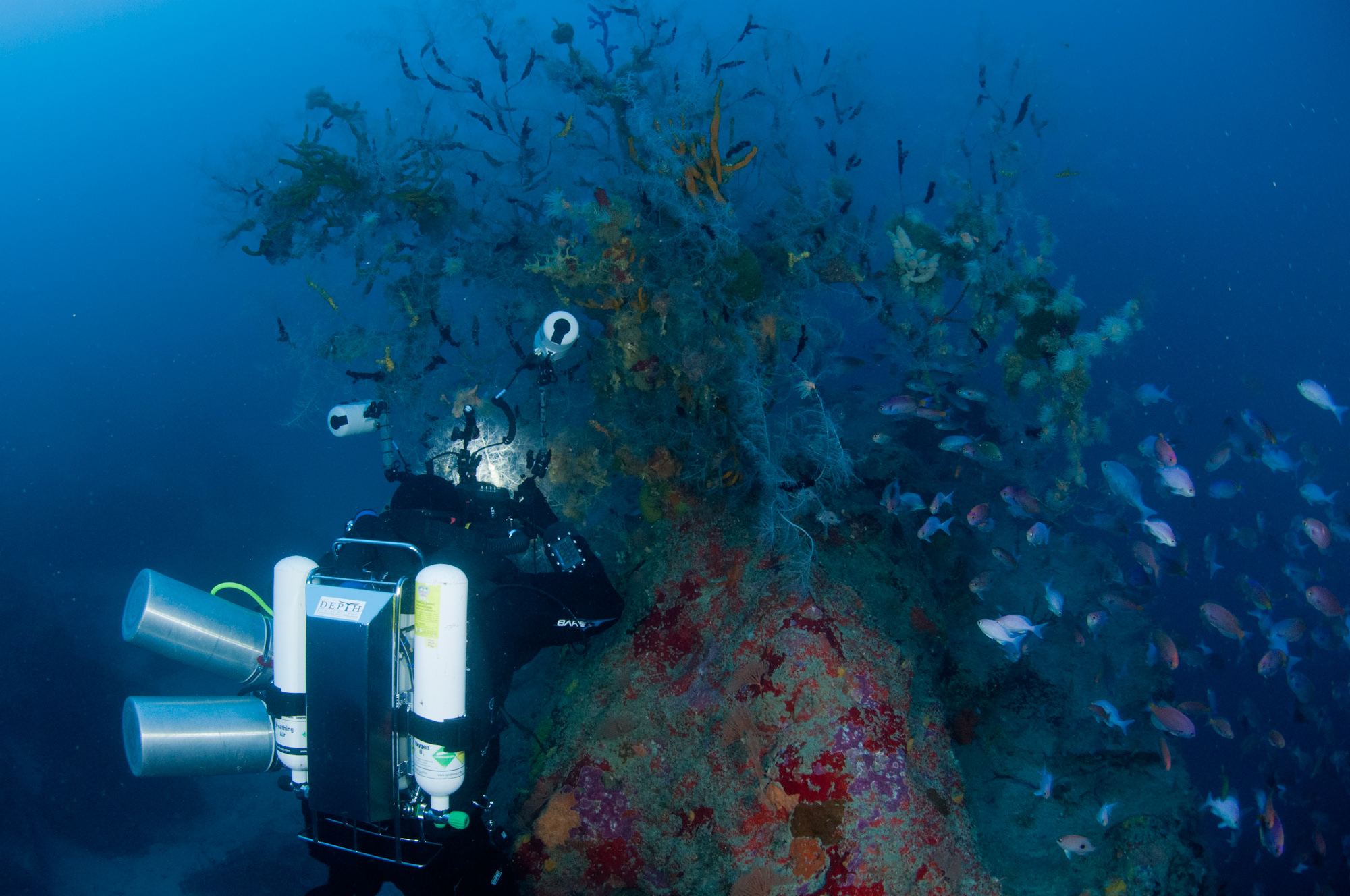
On a dive where we missed the main reef and ended up slightly to to the north, an isolated patch of reef emerged from out of the gloom as we swam down the sandy slope. At its deepest point, we found small black coral trees festooned with anemones and surrounded by schooling spendid perch and pink mao mao. An unusual looking growth on primnoides gorgonians at 66 metres turned out to be a spindle cowrie, a creature which had eluded me until then. We call this Little Wade's World. |
|||




Simo's (South of Labrid Channel, near Ngaio Rock)
Rocky spires and huge boulders gradually slope away to more than 75 metres.
Serpent Rock
| A mid-sized black coral tree can be found at 37 metres off the south-western point. It is a little spindly but a nice specimen considering the relatively shallow depth. At the south-western point, the wall drops steeply to a sandy bottom at about 62 metres. Heading clockwise from the point, the north-western face of the rock has very large boulders tumbling to the sand at about 70 metres depth. In this area, schools of the Deepsea damselfish, Chromis abyssicola, a deep water relative of the demoiselle can be found. Where the reef meets the sand, I have gazed out into the blue in search of the fabled “Kamikaze drop-off” described in Peter Rippon’s Diver’s Handbook. Unfortunately, it doesn’t seem to exist. The sandy bottom simply slopes away gradually from 70 metres. |
 Chromis abyssicola at 63m |

Sugarloaf
The grandaddy of them all, the northern flank of the Sugarloaf yields the Knights' deepest dropoff, plummeting almost vertically to 85 metres before the bottom appears from out of the gloom.
The deep walls are a little barren but there are some small black coral trees and a few clumps of Oculina can be found under small overhangs at around 70 metres.
The Sugarloaf is an exposed site requiring good sea conditions. There is often some current around the rock but this can be easily handled by swimming with it until it drops off. Current tends to be more pronounced at the eastern and western points where fish life aggregates providing a good opportunity to see bronze whaler sharks.
 Spawning male splendid perch (Callanthias australis) at 57m |
 Divers at 60m |

North Reef
Coordinates: 35.430S 174.746E
Black Forest
Coordinates: 35.469S 174.717E
© 2013 ianskipworth.com